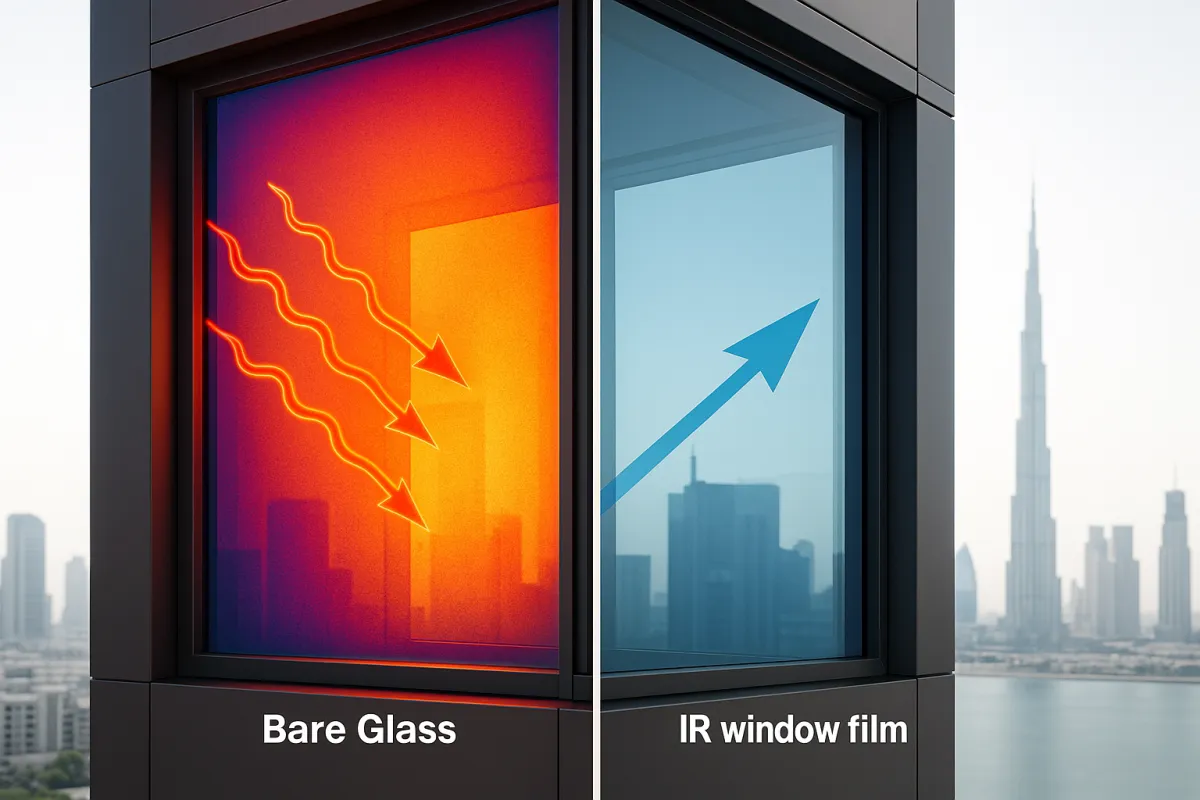
Clear vs Reflective Window Film: Which Suits Your Glass?
Clear vs Reflective Window Film: Which Suits Your Glass?
Choose reflective window film when you want the most heat cut and daytime privacy, and you are happy with a mirror look from outside. Choose a clear (near-clear IR) film when your community, tower or landlord does not allow a mirror finish, or when you want the glass to look almost unchanged.
Both block UV. They differ in look, heat cut, privacy and cost. Elite Window Films explains each below, using the Global films we supply and install across the UAE.
What Is Clear Window Film?
"Clear" can mean two different products.
Clear IR heat rejection film, such as Ice Cool Grey 70, is a solar control film made to keep the glass looking almost clear. It is the usual choice for communities and towers that do not allow a mirror look, and for buildings where the owner wants to keep the original appearance.
Clear safety film (4 mil or 8 mil) is a different product. It is made to hold broken glass together, and it blocks over 99% of UV. But clear safety film rejects little heat. If heat is your main problem, a clear safety film on its own will not solve it. You can read more on our safety window film page.
What Is Reflective Window Film?
Reflective film has a metallised layer that bounces part of the sun's energy away from the glass. From outside it looks like a mirror or a light mirror, depending on the shade.
Common Global reflective options include:
- Reflective Silver 20 or Dual Reflective Charcoal 05 – a full mirror look from outside.
- Reflective Silver 35 or 50 – a light mirror look. These lighter films keep rooms brighter.
- Dual Reflective Charcoal 15 or 25 – mirror outside, dark grey inside.
- Reflective Silver 15 Exterior – applied outside the glass, used on skylights and atriums.
Dual Reflective Charcoal 05 rejects up to 82% of solar heat. Dual Reflective Charcoal is also our most popular villa film in Abu Dhabi, giving a mirror look outside with a clear view from inside.
Clear vs Reflective: Side-by-Side Comparison
| Point | Clear IR film (e.g. Ice Cool Grey 70) | Reflective film (e.g. Silver 20, Dual Reflective Charcoal) |
|---|---|---|
| Look from outside | Almost clear | Mirror or light mirror |
| Heat rejection | Good, without changing the look | Highest; Dual Reflective Charcoal 05 rejects up to 82% of solar heat |
| Daytime privacy | Little | Good when it is brighter outside than inside |
| Night privacy | None | None with lights on inside |
| UV block | Global films block over 99% of UV | Global films block over 99% of UV |
| Best for | Communities and towers with facade rules, keeping the original look | West and south glass, villas wanting daytime privacy, skylights (exterior grades) |
| Typical installed price | AED 150–200 per sqm | Interior reflective AED 95–130; dual reflective charcoal AED 110–150; exterior reflective AED 115–160 per sqm |
Prices are typical installed rates per square metre from our window film price guide for Dubai. Larger areas get a lower rate.
Heat Rejection: Why Reflective Usually Wins
Reflective film stops more heat because it sends sunlight back out before it warms the room. That is why it is the usual pick for west-facing and south-facing glass, where rooms are hardest to cool.
A clear IR film still reduces heat and is the right answer when a mirror look is not allowed.
One result we measured came from an exterior reflective film. On an outlet mall skylight in Al Ain, solar heat through the glass measured 183 W/m² before and 16–17 W/m² after Reflective Silver 15 Exterior film was applied. That is one measured skylight, not a promise for every building, but it shows what reflective exterior film can do on strongly sun-exposed glass. See our skylight window film guide for more.
Privacy: Be Clear About the Limits
Reflective film gives privacy only when it is brighter outside than inside. In the day, people outside see a mirror. At night, with your lights on, the effect flips and people can see in.
Clear film gives almost no privacy at any time. If you need privacy at night, use frosted, matte or blackout film on those windows, or pair film with curtains or blinds.
Community Rules and Building Looks
Some communities, towers and landlords do not allow a mirror finish on the facade. In those cases a near-clear film such as Ice Cool Grey 70 lets you cut heat while keeping the building's original look. Check your community rules before you choose a reflective film.
Glass Type Matters for Both
Some dark interior films can heat double glazing too much. Before any installation we check the glass build-up and choose an approved interior film, or an exterior film where needed. On sealed units such as skylights, exterior film is usually the better choice because it stops heat on the outer surface, before it enters the glass.
Warranty and Supply
Global films come with a written warranty of up to 10 years for interior films and up to 7 years for exterior films, depending on the product. For installers and projects, we hold Global film rolls in 48, 60 and 72 inch widths. For homes see our window tinting in Dubai page, and for offices and towers see commercial window film in the UAE.
Frequently Asked Questions
Does clear window film reduce heat?
A clear IR film such as Ice Cool Grey 70 does reduce heat while keeping the glass almost clear. Clear safety film is different: it blocks UV but rejects little heat.
Is reflective film better than clear film?
For pure heat rejection, usually yes. Clear film is better when a mirror look is not allowed or you want the glass to look unchanged.
Can people see in through reflective film at night?
Yes. With lights on inside at night, reflective film gives no privacy. Use frosted, matte or blackout film, or curtains, for night privacy.
Which costs more, clear or reflective film?
Clear IR heat rejection film is typically AED 150–200 per sqm installed, while interior reflective film is typically AED 95–130 per sqm. Your final price depends on the film, area and access.
Can I put reflective film on double-glazed windows?
Often yes, but some dark interior films can overheat double glazing. We check the glass first and use an approved interior film or an exterior film where needed.
Talk to Elite Window Films
Elite Window Films FZE
Business Centre, Sharjah Publishing City Free Zone, Sharjah
Phone and WhatsApp: +971 56 702 7879
Email: [email protected]
