How Window Film Improves Building Energy Efficiency
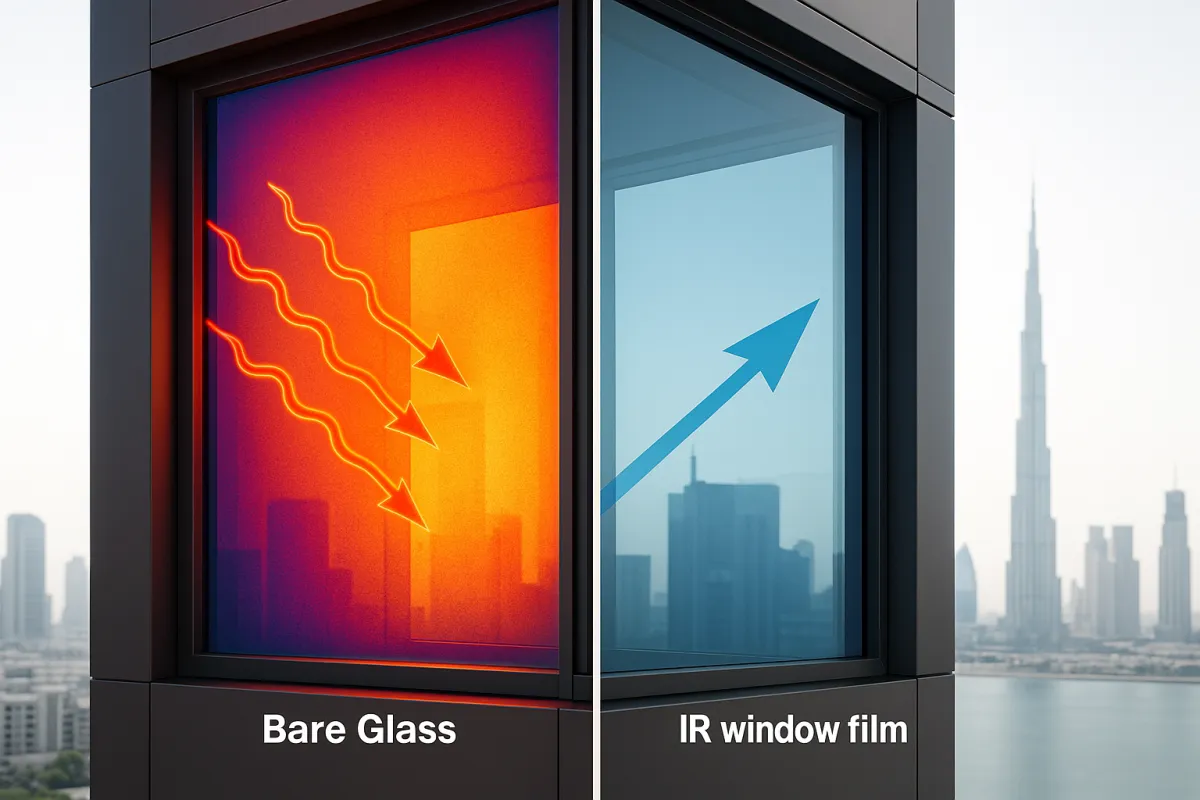
Architectural window film improves a building's energy efficiency by stopping part of the sun's heat at the glass, before it reaches the rooms the air conditioning has to cool. Less solar heat coming in means a lower cooling load, so the AC runs less, though how much energy a building saves depends on its glass, orientation, use and cooling system.
Elite Window Films supplies and installs Global window films across the UAE. This guide explains how the film works, which films suit which glass, and what you can and cannot expect.
Why glass is the weak point in a UAE building
Walls and roofs are insulated. Glass is not, in the same way. Sunlight passes straight through it as visible light, infrared heat and UV, and that energy turns into heat once it hits floors, desks and furniture inside.
In the UAE the sun is strong for most of the year. West and south facades, glass atriums and skylights can make spaces hard to cool, even with a large AC system running all day.
How solar control film cuts heat gain
Solar control film is a thin polyester film with metal or ceramic layers, bonded to the glass. It works in two main ways:
Reflecting: reflective films bounce part of the sun's energy back out before it enters the room.
Selecting: clear IR and spectrally selective films let a good share of daylight through while blocking more of the invisible infrared heat.
Global films block over 99% of UV, and Dual Reflective Charcoal 05 rejects up to 82% of solar heat. When less heat enters, the AC has less to remove, and rooms near the glass feel more even in temperature.
There is a second gain too. Less glare means people are less likely to close blinds and switch on lights during the day, so more of the building can work with natural light.
A measured example: Al Ain mall skylight
An outlet mall skylight in Al Ain was measured at 183 W/m² of heat coming through the bare glass. After Reflective Silver 15 Exterior film was applied, the same skylight measured 16 to 17 W/m². That is about 90% less heat through that glass.
This is one result on one skylight. It shows the mechanism clearly, but it is not a promise of the same figure on every building. More detail is in our skylight window film guide.
Choosing the right film for each part of the building
Area | Typical film | Why | Installed price (AED per sqm) |
|---|---|---|---|
Offices and rooms with ordinary glass | Interior reflective or dual reflective | Strong heat and glare cut | 95–150 |
Glass under facade or landlord rules | Ice Cool Grey 70 (clear IR) | Keeps the glass looking almost clear | 150–200 |
Skylights, atriums, many double-glazed units | Reflective Silver 15 or 20 Exterior | Stops heat on the outer surface | 115–160 |
Spaces that need daylight | Spectrally selective exterior | Less heat with more light | 190+ |
Prices include supply and installation and change with total area, access, height and old film removal. Larger jobs get lower rates. See the full breakdown in our window film price guide.
Interior or exterior film on double glazing
Many commercial buildings in the UAE use sealed double-glazed units. Some dark interior films can make the glass absorb too much heat inside the sealed unit. That is why we check the glass first and often recommend exterior film for skylights, atriums and large sealed units. Exterior film stops heat on the outer surface so the unit is not overheated.
Exterior films carry a written warranty of up to 7 years and interior films up to 10 years, depending on the product.
What window film will not do
It helps to be clear about limits, so you can plan with real expectations:
Film reduces solar heat through glass. It does not fix poor insulation, air leaks or an old, inefficient AC plant.
Energy savings vary. A building with a lot of sun-facing glass will usually see more benefit than one with small, shaded windows.
Clear safety film rejects little heat. If you need both safety and heat control, the films must be chosen for both.
Mirror and reflective films give daytime privacy only. At night, with lights on inside, people can see in.
How a commercial project works
We start with a site survey to check each type of glass and which facades take the most sun. For larger buildings we can fit a mock-up panel so you see the film on your own glass, and we can prepare a heat-gain and cooling estimate for the building.
Installation can be done at night or on weekends to avoid disruption. Global film rolls are held in 48, 60 and 72 inch widths, which helps on large panes. You receive a written warranty when the job is complete. Read more on our commercial window film page.
Frequently asked questions
Does window film really reduce energy use?
It reduces the solar heat entering through glass, so the AC has less heat to remove. The actual energy saving depends on the building, the glass area and orientation, and the cooling system.
How much will we save on electricity bills?
We do not quote a fixed percentage, because every building is different. For commercial projects we can prepare an estimate based on your glass and orientation.
Which film gives the biggest heat cut?
Reflective and dual reflective films give the strongest cut. Dual Reflective Charcoal 05 rejects up to 82% of solar heat. On skylights, exterior Reflective Silver 15 is our highest heat-cut choice.
Can we cut heat without a mirror look?
Yes. Ice Cool Grey 70 keeps glass looking almost clear, and spectrally selective exterior film lets in more daylight. Both cut less heat than strong reflective films.
Is film safe on double-glazed facades?
Yes, with the right film. We check the glass first and use suitable interior film or exterior film where needed.
Contact Elite Window Films
Elite Window Films FZE
Business Centre, Sharjah Publishing City Free Zone, Sharjah
Phone and WhatsApp: +971 56 702 7879
Email: [email protected]
