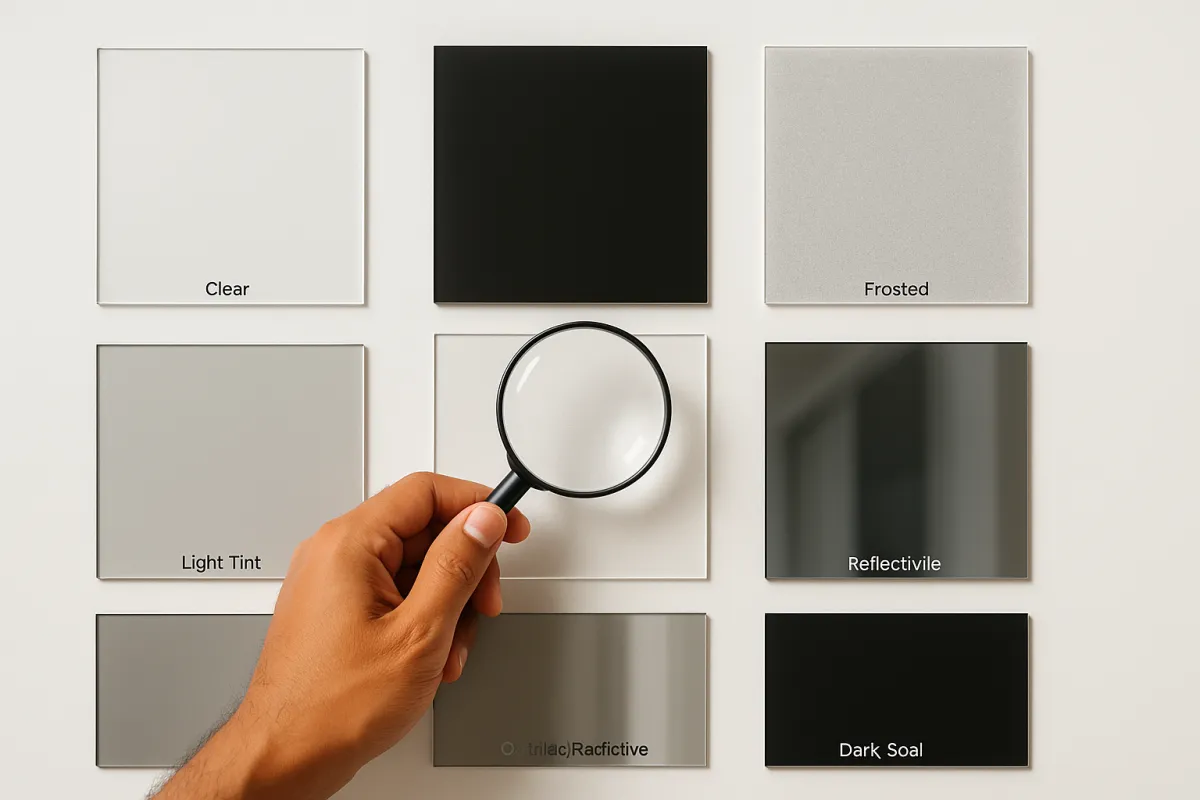
VLT, TSER, UV and SHGC Explained: Window Film Specs
VLT tells you how much daylight a window film lets through, TSER tells you how much of the sun's total energy it keeps out, UV rejection tells you how much ultraviolet it blocks, and SHGC tells you how much solar heat still gets in. For heat in a UAE home or office, TSER and SHGC matter most; VLT tells you how dark the glass will look, and UV tells you about fading.
These four numbers appear on every window film data sheet. This guide explains each one in plain English so you can compare quotes properly.
VLT: how much daylight comes through
VLT stands for visible light transmitted. It is a percentage. A high VLT means a bright, clear-looking window. A low VLT means a darker window with less glare.
VLT is about light, not heat. A dark film does not always reject more heat than a lighter one. Some near-clear films, such as Ice Cool Grey 70 IR film, keep the glass looking almost clear while still cutting heat, because they target the infrared part of sunlight rather than visible light.
VLT also has nothing to do with privacy at night. Mirror and reflective films give privacy only when it is brighter outside than inside. After dark, with lights on, people can see in. For night privacy you need frosted, matte or blackout film.
TSER: how much of the sun's energy is kept out
TSER stands for total solar energy rejected. It covers all of the sun's energy that reaches the glass: visible light, infrared and UV. A higher TSER means less heat enters the room.
This is the best single figure for comparing heat performance. For example, Global Dual Reflective Charcoal 05 rejects up to 82% of solar heat. Exterior films such as Reflective Silver 15 Exterior and Reflective Silver 20 Exterior reject up to 90% of solar energy, depending on the glass.
When you compare two quotes, ask for the TSER figure from each film's data sheet. Do not rely on words like "high heat rejection" without a number.
SHGC: how much solar heat gets in
SHGC stands for solar heat gain coefficient. It is a number between 0 and 1 that shows the share of solar heat that passes through the glass and film. Lower is better.
SHGC and TSER look at the same problem from opposite sides. TSER is the heat kept out; SHGC is the heat let in. A film with a high TSER will have a low SHGC. Architects and consultants often use SHGC, while homeowners usually find TSER easier to read.
UV rejection: what it means for fading
UV rejection is the percentage of ultraviolet rays the film blocks. UV is a main cause of fading in floors, furniture, curtains and artwork.
The Global films Elite Window Films supplies, including clear 4 mil and 8 mil safety film, block over 99% of UV. Because almost every quality film scores this high, UV rejection rarely helps you choose between films. It also tells you very little about heat, since UV is only a small part of the sun's energy. A clear safety film can block over 99% of UV and still reject little heat.
The four numbers side by side
Term | What it measures | Better is | What it does not tell you |
|---|---|---|---|
VLT | Daylight let through (%) | Depends on whether you want bright or dark glass | Heat rejection or night privacy |
TSER | Total solar energy kept out (%) | Higher | How dark or reflective the film looks |
SHGC | Share of solar heat let in (0 to 1) | Lower | Glare or appearance |
UV rejection | Ultraviolet blocked (%) | Higher | Heat performance |
What these numbers look like on a real building
Data sheet figures are measured in standard conditions. On site, results depend on the glass, the orientation and the shading. One measured example: on a mall skylight in Al Ain, heat coming through the glass was 183 W/m² before film. After Reflective Silver 15 Exterior film was fitted, it measured 16 to 17 W/m².
Lower solar heat through the glass means less cooling load on the air conditioning. How much that changes your electricity or DEWA bill depends on the building, so we do not quote a fixed saving.
Glass type matters as much as the film
The same film behaves differently on single glass, tinted glass and double glazing. Some dark interior films can heat double glazing too much, because the sealed unit absorbs the heat. That is why we check the glass first, and why exterior film is often the safer choice on double-glazed units and skylights. You can read more on our window tinting Dubai page and, for offices and towers, our commercial window film UAE page.
How to use the numbers when choosing a film
Want less heat: compare TSER (higher) or SHGC (lower).
Want to keep a clear look or follow community rules: look for a high VLT film with good heat rejection, such as Ice Cool Grey 70.
Want less glare on screens: a lower VLT will help.
Want to stop fading: check UV rejection, then choose on the other numbers.
Want privacy at night: ignore VLT and choose frosted, matte or blackout film.
Interior solar film is typically AED 95 to 150 per sqm installed, and exterior or premium IR films cost more. See our window film price guide for Dubai for a full breakdown. Written warranty is up to 10 years for interior films and up to 7 years for exterior films, depending on the product.
FAQs
Is a lower VLT film always cooler?
No. VLT measures light, not heat. Check TSER or SHGC to compare heat performance.
What is the difference between TSER and SHGC?
TSER is the share of solar energy kept out; SHGC is the share of solar heat let in. A high TSER goes with a low SHGC.
Do all window films block UV?
The Global films we supply block over 99% of UV, including clear safety film. UV blocking alone does not mean a film cuts heat.
Does a dark or mirror film give privacy at night?
No. With lights on inside after dark, people can see in. Use frosted, matte or blackout film for night privacy.
Will the data sheet figure match my building?
Not exactly. Glass type, orientation and shading change results, which is why we survey the glass before recommending a film.
Elite Window Films FZE
Business Centre, Sharjah Publishing City Free Zone, Sharjah
Phone and WhatsApp: +971 56 702 7879
Email: [email protected]
