Commercial Solar Control Window Film UAE: A Buyer's Guide
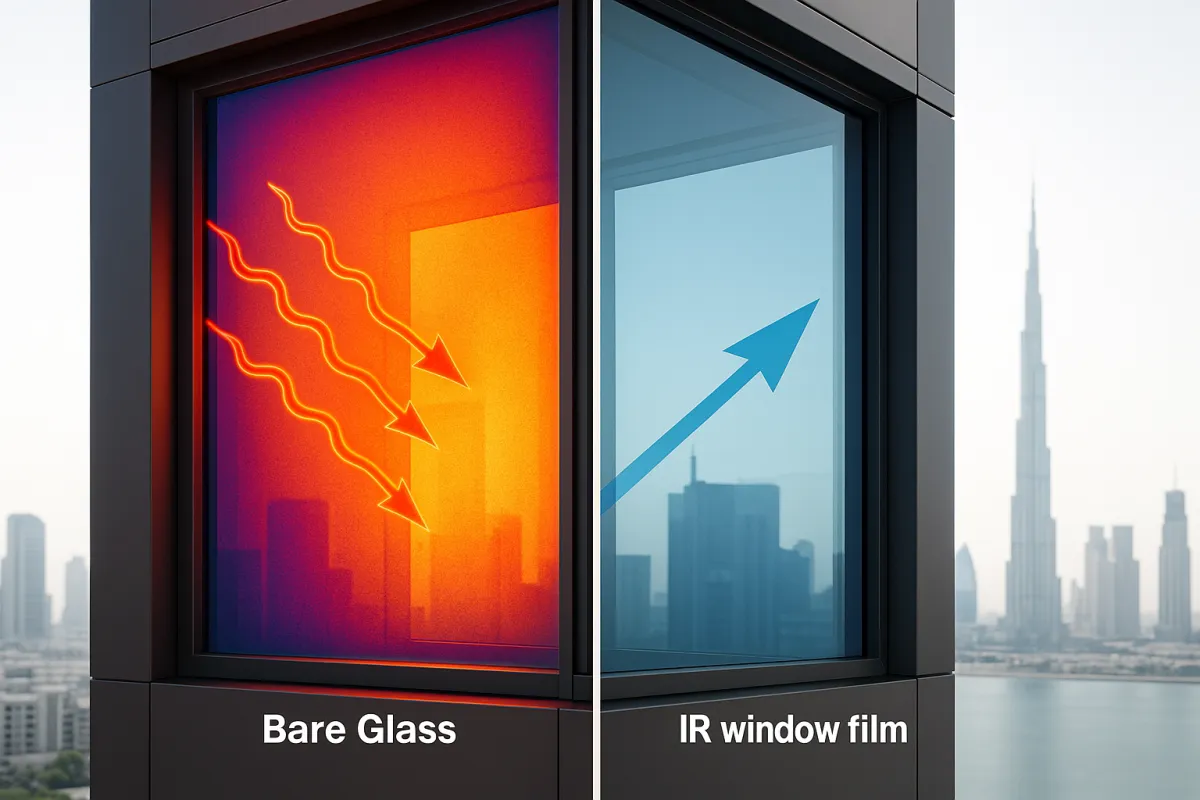
Commercial solar control window film in the UAE is a thin film fitted to existing glass that rejects part of the sun's heat and glare before it reaches the space inside. For most commercial buildings the right choice depends less on the brand and more on the glass, the elevation and the rules of the building, so the buying process matters as much as the film.
This guide is for facility managers, fit-out and MEP contractors, and operators of malls, schools, hotels, clinics and warehouses. It explains how the film works, which type suits which part of a building, and the steps that stop a project going wrong.
The problem: glass is where commercial buildings take the heat
In the UAE, large glazed areas face strong sun for most of the year. West and south facades heat up desks and shop floors in the afternoon, skylights and atriums pour heat straight down onto people, and glare forces staff to close blinds and switch lights on. Replacing glass is slow, disruptive and expensive in an occupied building, which is why many owners look at film first.
The catch is that a commercial estate is rarely one kind of glass. A single mall can have single-glazed shopfronts, double-glazed curtain walls and a skylight, each needing a different answer.
How commercial solar control window film works
Solar control films use metallised, dyed or spectrally selective layers to reflect or absorb part of the sun's energy. Quality films also block over 99% of UV, which slows fading of finishes and stock. When you compare products, read the data sheet rather than the brochure:
- Visible light transmitted (VLT): how much daylight still comes in.
- Total solar energy rejected: the best single figure for heat.
- Glare reduction and external reflectance: how dark and how mirrored it will look.
- UV rejection: usually over 99% on quality films.
A darker or more reflective film normally rejects more heat but lets in less daylight. Clear films keep the view and light but reject less heat, so be wary of any "invisible film, maximum heat rejection" promise.
Film options by building area
| Area | Typical film | Why |
|---|---|---|
| Skylights and atriums | Reflective Silver 15 or 20, applied on the outside | Direct overhead sun; exterior film stops heat before it enters the glass |
| West and south facades | Reflective Silver 20/35 or Dual Reflective Charcoal | Strong afternoon heat and glare |
| Glass under facade or landlord rules | Ice Cool Grey 70 (near-clear) | Keeps the building's appearance |
| Schools, clinics, ground floors | 4 mil or 8 mil clear safety film | Holds broken glass together; little heat rejection |
| Meeting rooms and partitions | Frosted, matte or blackout film | Privacy rather than heat |
| Warehouses and stores | Reflective or blackout film | Heat and light control where views matter less |
These are the Global films Elite Window Films supplies and installs. As a guide to performance on the data sheets, Reflective Silver 15 Exterior rejects about 85% of solar energy on clear glass, and Dual Reflective Charcoal 05 rejects up to 82% of solar heat. Real results depend on the glass and the building.
The selection process that avoids problems
- Survey and glass check. Record the glass type (single, double, laminated, tinted), its size, orientation and condition. Chipped edges or failing seals should be found before film goes on.
- Thermal stress check on double glazing. Dark or highly absorbent film on the inside of some double-glazed or tinted units can raise glass temperature. Many sealed units need a lighter interior film or an exterior film instead.
- Interior or exterior. Exterior film is usually the better choice for skylights and many double-glazed units because it rejects heat before it reaches the glass; interior film lasts longer and is easier to fit.
- Mock-up panel. Install one panel on site so the owner, tenants and landlord can see the look by day and by night.
- Read the warranty terms. Warranties run up to 10 years for interior film and up to 7 years for exterior film, depending on product. Check what is covered, and whether the glass and installation are included.
- Plan the installation. Mall and office work is often done at night or at weekends to avoid disruption, and high-level skylight or facade work needs access equipment and a method statement.
- Check building approvals. Many towers and communities control external appearance, so get facade or landlord approval before ordering reflective film.
Benefits, with honest limits
Film reduces solar heat through the glass, cuts glare on screens and blocks over 99% of UV. It can make hot zones near glass usable again and reduce the load on air conditioning. How much energy that saves depends on the building, its glazing, its orientation and how it is cooled, so treat any fixed savings percentage with caution.
Film does not make glass unbreakable, and mirror-look film gives little privacy at night when lights are on inside.
What this looks like in UAE buildings
In an office tower, west-facing floors are often treated with a reflective or dual reflective film while the north side is left clear. In a mall, the skylight is the usual priority. On an outlet mall skylight in Al Ain, our team measured solar energy through the glass at 183 W/m² before exterior Reflective Silver 15 film and 16–17 W/m² after, using a BTU meter; that is our own measurement on one skylight, not a guarantee for every roof. In schools and clinics, clear safety film on low glass is often combined with solar film on the hottest elevations. Warehouses tend to use reflective or blackout film on roof lights and high windows.
You can read more about roof glazing in our guide to skylight window film in the UAE.
What it costs
Interior solar film is typically AED 95–150 per square metre installed. Exterior reflective film is typically AED 115–160 per square metre, and spectrally selective exterior film starts from about AED 190. Large projects are usually priced per job after a survey. See our window film price guide for Dubai for what changes the price.
FAQs
Can solar control film go on double-glazed commercial windows?
Often yes, but the film must suit the unit. A glass check decides whether a lighter interior film is safe or whether an exterior film is the better option.
Will reflective film be allowed on my building?
It depends on the building. Many towers, malls and communities have facade rules, so get approval first. A near-clear film such as Ice Cool Grey 70 is often used where the look must not change.
Can installation be done without closing the building?
Usually. Commercial jobs are commonly scheduled at night or at weekends, area by area, so the building keeps operating.
How long does commercial window film last?
It depends on the product and whether it is inside or outside. Warranties run up to 10 years for interior film and up to 7 years for exterior film.
Does solar film also protect against broken glass?
Standard solar film adds little. For impact or breakage concerns, clear safety film (4 mil or 8 mil) is the right product; it holds broken glass together but does not make glass unbreakable.
Conclusion
The best commercial solar control window film for a UAE building is the one matched to each piece of glass: exterior film for skylights and many sealed units, reflective or dual reflective film for hot facades, and near-clear film where the look must stay the same. Start with a survey and glass check, approve a mock-up panel, and agree the warranty in writing before work starts.
Elite Window Films has supplied and installed Global window film since 2006, with its own installation team in every emirate. See our commercial window film services for building types and films.
Book a site survey with Elite Window Films
Call / WhatsApp: +971 56 702 7879
Email: [email protected]
Business Centre, Sharjah Publishing City Free Zone, Sharjah. Installing across all emirates.
